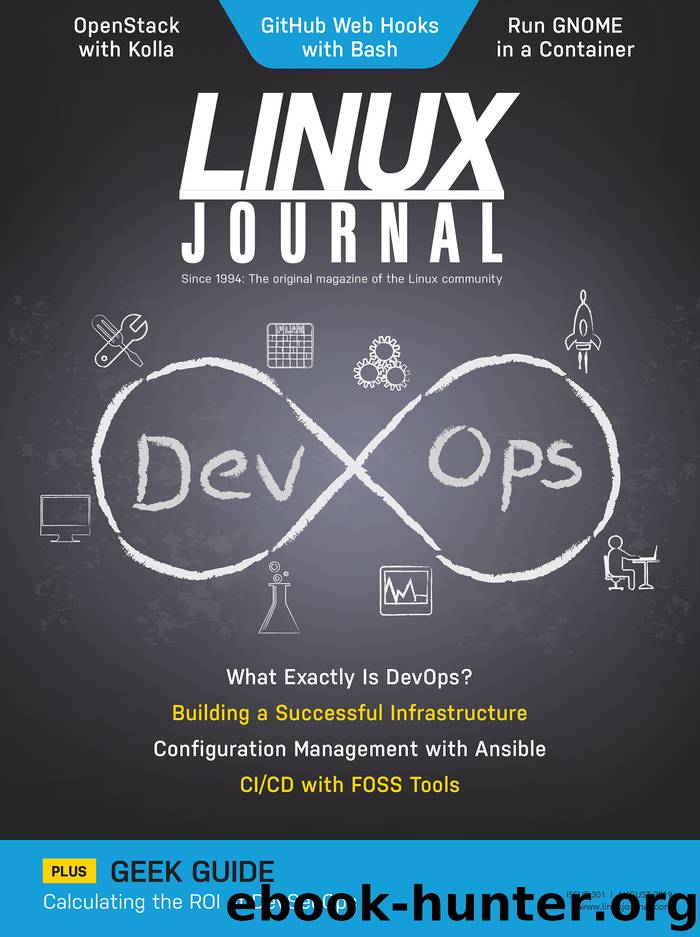
Linux Journal August 2019 by Linux Journal
Author:Linux Journal
Language: eng
Format: mobi, epub
Tags: Linux
Publisher: Linux Journal
Published: 2019-07-30T05:00:00+00:00
Get a list of servers that run that software.
Start with the first server on the list.
Set a maintenance mode in monitoring for that server.
Tell any load balancers to move traffic away from the server.
Stop the service.
Update the software.
Confirm the software is at the correct version.
Start the service.
Test the service.
Tell any load balancers to move traffic back to the server.
End the maintenance mode.
Repeat for the rest of the hosts.
All I did was take each of the above steps and make sure there was a corresponding MCollective command for it. Most of the steps already had built-in MCollective plugins for them, but in a few cases, such as for the load balancers, I wrote a simple MCollective plugin for HAProxy that would control the load balancers. Remember, many of the servers in the environment had their own embedded HAProxy instance, but because MCollective runs in parallel, I could tell them all to redirect traffic at the same time.
Once each of these steps could be done with MCollective, the next step was to combine them all into a single generic script to deploy an application. I also added appropriate checks at each of the stages, so in the event of an error, the script would stop and exit with a descriptive error. In the development environment, we automatically pushed out updates once they passed all of their tests, so I also made sure that our continuous integration server (we used Jenkins) used this same script to deploy our app updates for dev. That way I could be sure the script was being tested all the time and could stage improvements there first.
Having a single script that would automate all of these steps for a single app was great, but the reality is that a modern service-oriented architecture has many of these little apps. You rarely deploy one at a time; instead, you have a production release that might contain five or more apps, each with their own versions. After doing this by hand a few times, I realized there was room to automate this as well.
The first step in automating production releases was to provide a production manifest my script could use to tell it what to do. A production manifest lists all of the different software a particular release will have and which versions you will use. In well organized companies, this sort of thing will be tracked in your ticketing system, so you can have proper approval and visibility into what software went to production when. This is especially handy if you have a problem later, because you more easily can answer the question "what changed?"
I decided to make the right approach the easy approach and use our actual production manifest ticket as input for the script. That meant if you wanted an automated production release, the first step was to create a properly formatted ticket with an appropriate title, containing a bulleted list of each piece of software you want to deploy and which version you intend on deploying, in the order you want them to be deployed.
Download
This site does not store any files on its server. We only index and link to content provided by other sites. Please contact the content providers to delete copyright contents if any and email us, we'll remove relevant links or contents immediately.
The Mikado Method by Ola Ellnestam Daniel Brolund(27095)
Hello! Python by Anthony Briggs(25950)
Secrets of the JavaScript Ninja by John Resig Bear Bibeault(25286)
Kotlin in Action by Dmitry Jemerov(24396)
The Well-Grounded Java Developer by Benjamin J. Evans Martijn Verburg(23591)
Dependency Injection in .NET by Mark Seemann(23313)
OCA Java SE 8 Programmer I Certification Guide by Mala Gupta(21948)
Algorithms of the Intelligent Web by Haralambos Marmanis;Dmitry Babenko(20852)
Grails in Action by Glen Smith Peter Ledbrook(19869)
Adobe Camera Raw For Digital Photographers Only by Rob Sheppard(17073)
Sass and Compass in Action by Wynn Netherland Nathan Weizenbaum Chris Eppstein Brandon Mathis(16833)
Secrets of the JavaScript Ninja by John Resig & Bear Bibeault(14464)
Test-Driven iOS Development with Swift 4 by Dominik Hauser(12584)
Jquery UI in Action : Master the concepts Of Jquery UI: A Step By Step Approach by ANMOL GOYAL(11866)
A Developer's Guide to Building Resilient Cloud Applications with Azure by Hamida Rebai Trabelsi(10652)
Hit Refresh by Satya Nadella(9239)
The Kubernetes Operator Framework Book by Michael Dame(8588)
Exploring Deepfakes by Bryan Lyon and Matt Tora(8446)
Robo-Advisor with Python by Aki Ranin(8391)
